
What to Look For in a Micro-Mesh Gutter Guard
By Dustin Drudy • August 18, 2026
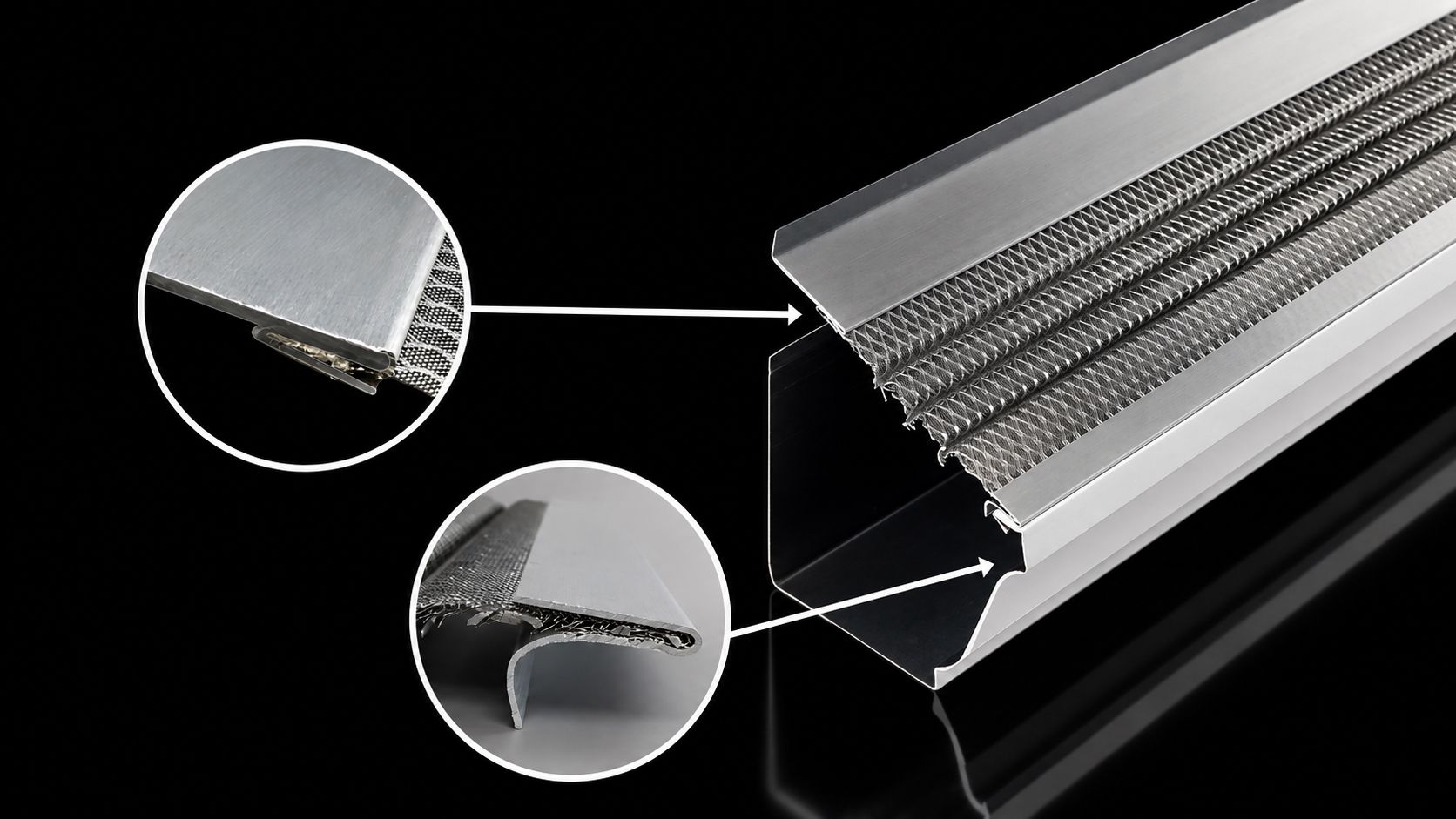
If you’ve done any research into gutter protection, you’ve probably already landed on micro-mesh as the category worth considering. That’s the right instinct. Micro-mesh is the only design that reliably keeps out the fine material that defeats everything else — pine needles, seed pods, shingle granules, roof grit.
Here’s the problem: “micro-mesh” describes a category, not a standard. Two products can both be sold as micro-mesh gutter guards and be almost nothing alike in how they’re built, how much water they handle, and how long they stay on the house. The word tells you what shape it is. It doesn’t tell you whether it’s any good.
Below is what to actually look at, in the order it matters, before you sign a contract with anyone.
1. What the mesh is made of
This is the first question, and a surprising number of salespeople answer it vaguely.
Stainless steel is the benchmark. It doesn’t rust, doesn’t corrode in wet-dry cycling, and holds its structure through years of freeze and thaw. Surgical-grade stainless is a further step up in corrosion resistance.
What to be careful about is mesh that’s plated, coated, or made from a lesser metal and finished to look like stainless. Coatings wear. Once the coating is compromised, corrosion starts at that point and spreads. If you’re being quoted a “steel” mesh, ask specifically whether it’s stainless throughout or a coated product, and ask what grade.
While you’re at it, ask for the mesh count and the actual opening size. A real manufacturer publishes these. The Leaf Solution Gutter Guard, for example, uses a 42-mesh surgical stainless steel with 440-micron openings — sized deliberately to pass water at volume while still stopping shingle grit. A number like that is checkable. “Fine micro-mesh” isn’t.
Ask: Is the mesh stainless steel all the way through, what grade, and what’s the mesh count and opening size?
2. How the mesh is attached to the body
This is the single most overlooked spec in the category, and in the field it’s the most common way a micro-mesh guard fails.
The mesh has to be joined to the metal body somehow. If it’s glued, the adhesive degrades under UV and thermal cycling. If it’s spot-welded or lightly crimped, that bond fatigues as the panel expands and contracts through thousands of hot-cold cycles. Once the mesh lifts even slightly along an edge, debris packs underneath it and water bypasses the filter entirely. The guard looks fine from the ground. It has stopped working.
There’s a more basic version of this problem worth knowing about, too. Many mesh screens aren’t fastened to a body at all — the mesh simply slides into the gutter channel and rests there, held by tension or a light clip. There’s nothing mechanically joining the mesh to a structural frame, so there’s nothing keeping it flat, correctly pitched, or in position as the seasons work on it. Those products can shift, dip in the middle, and pop loose entirely.
A mechanically locked joint — where the mesh is folded and crimped into the body rather than stuck to it or set loosely into the channel — doesn’t have those failure modes. Leaf Solution’s patented hemming process does exactly that: the stainless mesh is integrated both vertically and horizontally into a substrate, then mechanically crimped so the mesh and substrate are captured inside the body. It’s specifically engineered to prevent three things — separation, sagging, and stretching — and it’s on both the Leaf Solution Gutter Guard and Xtreme.
Ask: How is the mesh secured — does it just slide into the channel, or is it mechanically crimped into a body?
3. What the body is made of, and how rigid it is
The mesh does the filtering. The body does the structural work, and it’s what keeps the mesh flat and correctly angled for the next few decades.
Start with a question most homeowners never think to ask: is the body metal at all? Some micro-mesh systems — including several of the most heavily marketed ones — are built on a PVC plastic body with the mesh mounted to it. That detail rarely comes up in a sales presentation, and it’s easy to miss when you’re holding a short sample in your driveway, because the mesh is the part you’re looking at.
Plastic behaves nothing like aluminum on a roof. It expands and contracts far more with temperature swings, which works at every fastener and joint season after season. It can soften and warp in sustained summer heat, particularly on a south-facing run above dark shingles. And UV exposure makes it progressively brittle, so a body that flexed fine on installation day can crack years later when a ladder leans against it or a branch comes down. Once a plastic body warps, the mesh it carries is no longer flat or correctly pitched — and that’s the whole job.
Aluminum is the right material here. It doesn’t rust, it doesn’t degrade in sunlight, and it’s light enough not to load the gutter or the fascia behind it. Ask for the gauge — a real spec sounds like “a .024-inch polyester-painted aluminum body,” which is what the Leaf Solution Gutter Guard uses. Xtreme is built on an expanded aluminum substrate.
Material alone isn’t the whole story either. A flimsy panel bows under wet snow, water ponds on top of it, and the panel takes a permanent set it never recovers from. Look for a formed profile that adds real stiffness — a reinforced back bend, or a shape that adds box-like structural reinforcement to the gutter itself, so the guard strengthens the assembly instead of just covering it.
One related detail worth asking about: what happens where two different metals meet. Dissimilar metals in contact, with water running across them, can drive galvanic corrosion. A system engineered as a system — stainless mesh matched to a body designed to carry it — avoids that.
If you’re weighing a metal-bodied system against a plastic-bodied one, you aren’t comparing two versions of the same product.
Ask: Is the body aluminum or plastic — and does the profile add rigidity to the gutter?
4. How much it weighs — and what that puts on your gutters
Weight is the spec almost nobody asks about, and it’s the one installers complain about most.
Some micro-mesh systems are built on heavy, over-engineered frames. That can sound like a virtue — heavier must mean sturdier — but consider what a gutter actually is: a long trough hung on spaced hangers fastened into fascia board. It was never designed to carry a substantial additional load along its entire length. Add enough weight and the guard starts working against the gutter it’s meant to protect. Hangers pull, the gutter sags between them, the pitch that carries water to the downspout flattens out, and in bad cases the gutter separates from the fascia. A winter’s worth of wet snow and ice sitting on top of an already-heavy system is usually what finishes the job.
There’s a knock-on effect too. Bulky, rigid frames are harder to handle on a ladder, harder to cut cleanly, and harder to fit to anything that isn’t a long straight run. Installers will tell you this directly. Harder to install means more rough cuts, more improvised corners, and more of the small execution errors that show up as leaks in year three. A guard that fights the installer tends to become a guard that underperforms.
The goal is a system rigid enough to hold its shape and stay correctly pitched, without loading the gutter down to get there. Leaf Solution products are engineered to be lightweight and easy to cut and fit — the formed profile adds structural reinforcement to the gutter rather than dead weight.
Ask: What does this system weigh per foot, and what is that adding to my gutters?
5. The water flow number
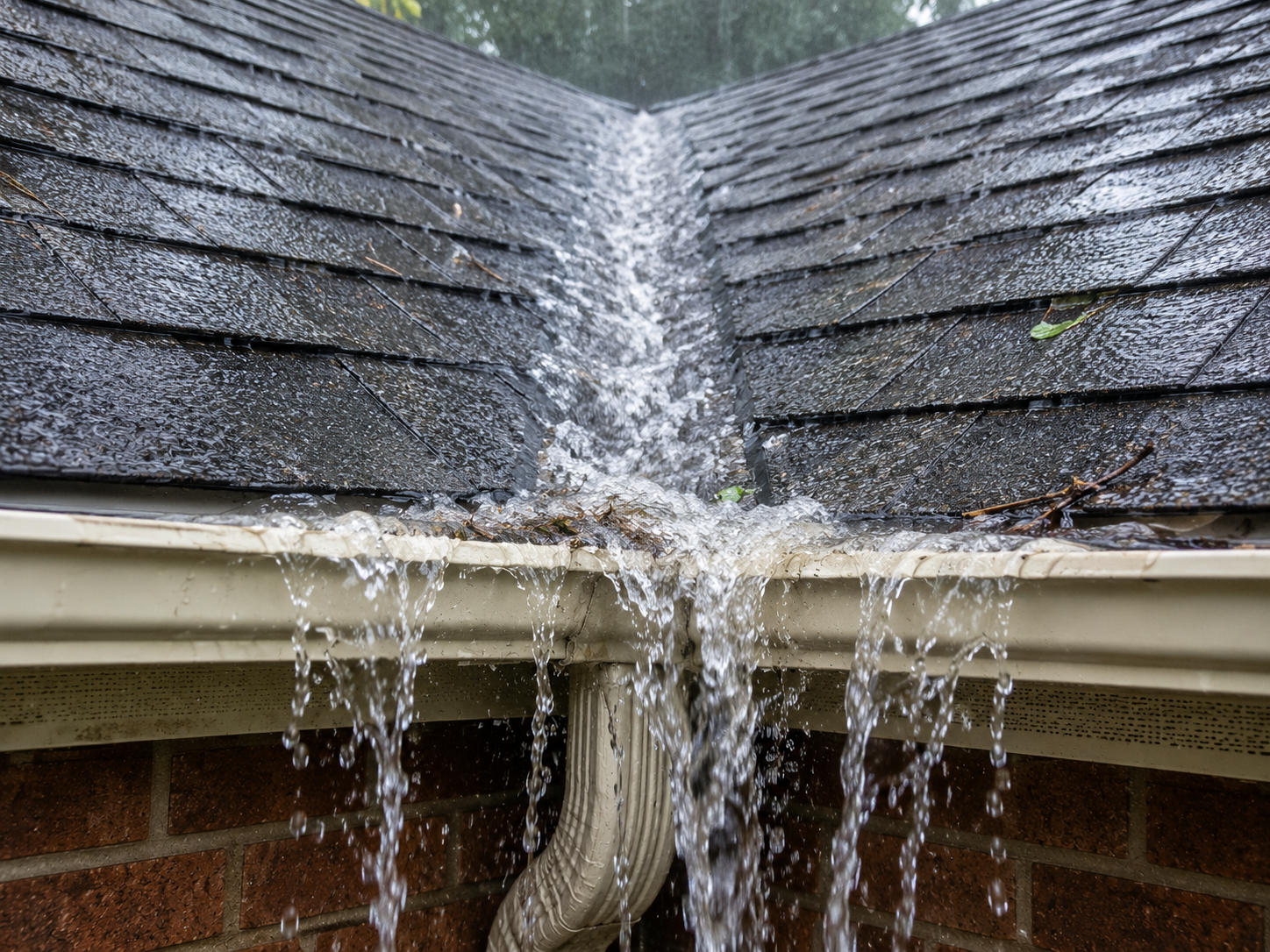
Micro-mesh has an inherent tension in it: openings small enough to block fine debris are also small enough to restrict water if the product isn’t engineered well. The difference between a good micro-mesh guard and a mediocre one shows up in a hard rain, when a poorly designed one sheets water straight over the front lip.
There’s a straightforward way to cut through it — ask for the throughput number, in gallons per minute. A company that has tested its product will have one. A company that hasn’t will change the subject.
For reference, both Leaf Solution micro-mesh lines are rated to handle up to 60 gallons per minute. That’s well beyond what a typical roof will deliver in a heavy storm, which is the margin you want.
There’s a second number worth asking for: percent open area, meaning how much of the mesh surface is actually open for water to pass through. It’s the spec that explains the flow rate rather than just asserting it. The Leaf Solution Gutter Guard runs 57% open area. Very few companies will have this number ready, and the ones that do have usually done the engineering.
Ask: How many gallons per minute is this rated for, and what’s the percent open area?
6. Whether it matches the debris — and the water volume — on your property
There’s no universally correct guard. There’s a correct guard for your trees and your rainfall.
If your property drops fine material — pine needles, maple seeds, oak tassels, shingle granules from an aging roof — you need genuine micro-mesh. Anything with larger openings will pass that material straight into the gutter, and you’ll be back on a ladder.
If your debris is almost entirely large material like leaves and sticks, a punched aluminum product handles it well and is a reasonable choice. Our New Wave Gutter Guard is built for exactly that situation.
The other half of this question is water. A steep roof feeding long valleys in a high-rainfall region is a different problem than a low-slope ranch under pine trees, and the better systems don’t force the same mesh onto both. Xtreme is offered in two mesh densities for this reason: a standard 42-mesh, which blocks shingle grit, pine needles, and small debris while maintaining strong water collection, and a high-flow 18-mesh, with larger openings engineered for heavy rainfall regions and maximum water volume. If a company offers exactly one mesh for every house in every climate, ask how they’re accounting for the difference.
Ask: Given the trees on my property and how hard it rains here, why is this the right product and the right mesh?
7. How corners and valleys are handled
Most gutter systems don’t fail in the middle of a run. They fail at the corners, and in the valleys where two roof planes funnel a huge volume of water into one short section of gutter.
A lot of installations treat this as an afterthought, cutting panels to fit and relying on sealant. Ask how the system handles corners specifically. Purpose-built miters and accessories exist for this — ours come in five configurations for different corner types, and in both standard and high-flow mesh, so a valley carrying serious water can be fitted to match instead of being forced onto the same mesh as the rest of the run.
Ask: How does this system handle corners and roof valleys?
8. Who installs it — and what that does to the warranty
Two identical guards can have completely different service lives depending on how they went on. Pitch determines whether debris sheds or sits — our micro-mesh products are specified to be installed at a 5–15° angle for exactly that reason, and hitting that consistently across a whole roofline is skilled work. Seam placement determines where water finds its way in. Fastening determines whether the panel survives decades of thermal movement without compromising the roofing above it.
It’s also worth asking how the system attaches. Both Leaf Solution micro-mesh products can be installed under the shingle or fascia-mounted, and a fascia mount secures to both the fascia and the gutter lip, which meaningfully strengthens the whole assembly. Having both options means the installer can fit the method to your roof instead of forcing one approach onto every house.
Most reputable manufacturers require certified installation, and most warranties are void without it. That requirement isn’t a sales tactic — improper installation is the leading cause of premature failure in this entire category. Leaf Solution gutter guards are installed exclusively through approved, trained contractors for that reason.
Ask: Who installs this, are they certified by the manufacturer, and what happens to my warranty if they aren’t?
9. What the warranty actually says
Nearly every guard in this category is sold with a “lifetime” warranty of some kind, which means the word has stopped carrying much information on its own. What matters is the document.
Read how it defines “lifetime” — the life of the original owner, a fixed number of years written into the fine print, or the life of the home. Check whether it transfers if you sell, and what that costs. Check whether it covers labor or only materials, because a materials-only warranty on a full-house replacement leaves you with most of the bill. And check the exclusions.
We’ve written a longer walkthrough of this: how to read a gutter guard warranty before you sign. It’s worth twenty minutes before a purchase this size.
Ask: Can I see the full warranty document, not the summary?
Red flags worth noticing
A few things that should slow you down regardless of brand:
- No throughput number. If nobody can tell you the gallons per minute, it likely hasn’t been tested.
- A fuzzy answer on what the body is made of. “Is this aluminum or plastic?” is a one-word question. If it takes a paragraph, you have your answer.
- Heaviness sold as strength. A heavy frame isn’t automatically a strong one, and your gutters are the thing carrying it. Rigidity should come from how the profile is formed, not from bulk.
- Vagueness about the mesh attachment. This is a spec, not a trade secret. A manufacturer proud of its construction will explain it.
- Pressure to sign today. Gutter protection is a decades-long decision on your house. Any offer that evaporates if you take a week to think isn’t an offer worth taking.
- A warranty summary instead of a warranty. The one-page marketing sheet is not the document you’re agreeing to.
- No answer on what happens at the valleys. That’s where the water is.
How the Leaf Solution micro-mesh lines answer these
We manufacture in Rochelle, Virginia, and have since 2002. Two of our lines are micro-mesh:
Leaf Solution Gutter Guard — 42-mesh surgical stainless steel with 440-micron openings on a .024-inch polyester-painted aluminum body with a reinforced back bend. 57% open area, rated to 60 gallons per minute. Its patented Triple-Dip Capillary Diversion System uses arc-shaped surfaces to deflect and force water into the gutter, even in torrential rain. Available in 5” and 6” widths and up to six colors with matching inside miters and end caps. Lifetime limited warranty.
Xtreme Gutter Guard — surgical stainless steel micro-mesh on a strong expanded aluminum substrate, low-profile, no dips. Offered in two mesh densities — standard 42-mesh and high-flow 18-mesh — so it can be matched to your rainfall. Also rated to 60 gallons per minute. Available in 5”, 6”, and 7” widths. Lifetime limited warranty.
On both, the mesh is integrated vertically and horizontally into a substrate and mechanically crimped into the body through our patented hemming process, specifically to prevent separation, sagging, and stretching. It isn’t glued on, and it doesn’t sit loose in the channel. Both are installed only by approved contractors, and full terms are on our warranty page.
We’re not going to tell you we’re the only good option. We will tell you that the nine questions above are the ones that separate products built to last from products built to sell, and that we’re comfortable answering all of them in writing.
Frequently asked questions
What should I look for in a micro-mesh gutter guard? Start with the mesh material and confirm it’s stainless steel throughout rather than coated. Then ask how the mesh is attached, since glued joints, spot welds, and screens that simply slide into the gutter channel are the most common failure points. From there, check the body material and rigidity, the rated water flow in gallons per minute, whether the mesh matches the debris and rainfall on your property, how corners and valleys are handled, whether installation is certified, and what the full warranty document actually says.
Are all micro-mesh gutter guards the same? No. Micro-mesh describes the general design, not a quality standard. Products sold under that label vary widely in mesh grade, how the mesh is joined to the frame, panel rigidity, and tested water throughput. Two guards can both be accurately described as micro-mesh and have very different service lives.
How many gallons per minute should a gutter guard handle? Ask for the tested number rather than a general claim. A well-engineered micro-mesh guard should handle far more water than a typical roof delivers in a heavy storm, which provides margin during downpours and when the mesh is partially loaded with debris. Both Leaf Solution micro-mesh products are rated for up to 60 gallons per minute.
Does micro-mesh clog? Fine debris can accumulate on the surface of any micro-mesh guard, but a properly designed and correctly pitched system sheds it as it dries rather than holding it. Problems usually trace back to insufficient pitch, an undersized flow rating, or mesh that has separated from the frame and is letting debris underneath.
Can gutter guards be too heavy for gutters? Yes. A gutter is a trough hung on spaced hangers fastened into fascia board, and it wasn’t designed to carry a large additional load across its full length. Some micro-mesh systems use heavy, over-engineered frames, and that added weight can pull hangers, let the gutter sag between them, flatten the pitch that moves water to the downspout, and in bad cases separate the gutter from the fascia — especially under wet snow and ice. Heavy frames are also harder to cut and fit, which makes installation errors more likely. Rigidity should come from how the profile is formed, not from sheer bulk.
Are micro-mesh gutter guards made of metal or plastic? Both exist, and the difference is significant. The mesh itself is typically metal, but the body it mounts to may be aluminum or PVC plastic depending on the manufacturer, and that isn’t always disclosed up front. Plastic expands and contracts more with temperature, can soften or warp in sustained heat, and grows brittle with UV exposure over time — and once the body distorts, the mesh it carries is no longer flat or correctly pitched. Aluminum doesn’t rust, doesn’t break down in sunlight, and holds its shape. Both Leaf Solution micro-mesh products use an aluminum body with the mesh mechanically crimped into it.
Do micro-mesh gutter guards come in different mesh sizes? The better ones do. Xtreme is offered in two densities: a standard 42-mesh that blocks shingle grit, pine needles, and small debris while maintaining strong water collection, and a high-flow 18-mesh with larger openings engineered for heavy rainfall regions and maximum water volume. Matching the mesh to your environment matters, because a steep roof with long valleys in a high-rainfall area has different requirements than a low-slope roof under pine trees. For reference, the Leaf Solution Gutter Guard uses a 42-mesh with 440-micron openings and 57% open area.
Should I choose micro-mesh or a punched aluminum guard? It depends on your debris. Fine material like pine needles, seed pods, and shingle granules requires micro-mesh, because larger openings will pass it straight into the gutter. If the debris on your property is almost entirely leaves and sticks, a punched aluminum product handles it well and is a sound choice.
The bottom line
Choosing gutter protection isn’t really a choice between brands. It’s a choice between a product engineered to survive twenty winters on your roof and one engineered to look good in a driveway presentation. The nine questions above will tell you which one you’re being shown, no matter whose logo is on the sample.
Find a Certified Installer and get straight answers about your specific roofline.
Related reading: Do Gutter Guards Actually Work? · How Long Do Gutter Guards Last? · The Homeowner’s Guide to Reading a Gutter Guard Warranty
Become a Contractor
Become a Registered Leaf Solution Installer Today and Get FREE Sample Kits Shipped Directly to You
Join Our Installer Newsletter
Get product updates, new pricing announcements, installation tips, and exclusive promotions delivered straight to your inbox.
Contact Us
Thank You for Joining the Leaf Solution Newsletter
You’re officially on the list.
You’ll now receive product updates, installer insights, new pricing announcements, and exclusive promotions delivered straight to your inbox.
We’re glad to have you with us.
Please try again later.
SHARE THIS
Latest Posts