Cleaning gutters is one of the most dangerous routine jobs in homeownership. Not because the work is hard — it’s tedious, but it isn’t difficult — but because of where it happens. Roughly half a million Americans end up in an emergency room every year from ladder-related injuries, and gutter cleaning is one of the leading causes.
That isn’t a reason to scare you off the ladder. It’s a reason to be deliberate about it. Below is how to do the job properly: how to decide whether you should be doing it at all, what gear actually matters, how to set a ladder so it doesn’t move, the step-by-step process, and the specific mistakes that put people in the hospital or damage the house.
First: decide whether this is a job you should be doing
Start here, before you think about method. There’s no prize for doing this yourself, and the honest answer for a lot of homes is that it isn’t worth it.
Reasonable to handle yourself:
a single-story home, a ladder that reaches comfortably, firm level ground to set it on, dry conditions, decent balance and upper-body strength, and someone else at home while you work.
Call a professional instead if any of these apply:
- The house is
two stories or taller. The height at which a fall becomes life-altering is lower than most people assume.
- The ground around the house is
soft, sloped, or uneven — flower beds, mulch, a hillside, a deck edge.
- There are
power lines anywhere near the roofline or the ladder’s path.
- The roof is
steep, metal, or slick with algae, and the job would require getting onto it.
- Conditions are
wet, windy, icy, or about to be.
- You have any issue with
balance, vertigo, joint strength, or a medication that affects either.
- You’d be working alone and nobody would know for hours if something went wrong.
None of that is a character judgment. Professional crews do this with proper equipment, on flat footing, several times a day, and they’re insured for it. That’s a reasonable thing to buy.
The gear that actually matters
You don’t need much, but the few things that matter, matter a lot.
A ladder that’s the right height and in good condition. It should be tall enough that you’re never standing on the top three rungs. If you’ll be stepping onto the roof, it needs to extend about three feet above the roof edge to give you something to hold. Check the rails and rungs for damage before every use, and confirm the duty rating covers your weight plus the tools and debris you’ll be carrying.
A ladder stabilizer, also called a standoff. This is the single most valuable thing on this list and the one most people skip. It’s an arm that mounts to the top of the ladder and braces against the fascia or roof instead of the gutter. It stops the ladder from resting on your gutter — which bends it and can pull it loose — and it widens the contact points so the ladder is far harder to tip sideways.
Cut-resistant gloves. Gutters hold sharp metal edges, exposed screws, and animal droppings. Fabric garden gloves aren’t enough.
Eye protection. You’ll be working above your own head, and dry debris comes down when you disturb it.
Shoes with real tread, clean and dry before you step on the first rung.
A bucket with an S-hook so it hangs from the ladder, plus a plastic gutter scoop or a stiff plastic putty knife. Plastic rather than metal — metal scratches the finish and can gouge seams.
A garden hose with a spray nozzle for flushing when the bulk debris is out.
Setting the ladder so it doesn’t move
Most gutter-cleaning injuries aren’t dramatic falls from the roof. They’re ladders that shifted.
Use the 4-to-1 rule. For every four feet of height to the point where the ladder touches the house, the base should sit one foot out from the wall. A ladder touching at 16 feet gets its base four feet out. Too steep and it tips backward; too shallow and the base slides.
Set it on firm, level ground. Not on mulch, not on a soft bed, not balanced on the edge of a deck step. If the ground is uneven, use a leveling accessory made for it — never a stack of scrap wood or bricks.
Extend about three feet above the roofline if you plan to get onto the roof, so you have something solid to hold while transitioning.
Have someone foot the ladder on anything but a short, stable setup.
Then, once you’re on it: three points of contact at all times — two hands and a foot, or two feet and a hand. Keep your belt buckle between the rails. The instant you want to reach a little farther, that’s your signal to climb down and move the ladder. Every over-reach is someone deciding that moving the ladder is more trouble than falling.
The cleaning process, step by step
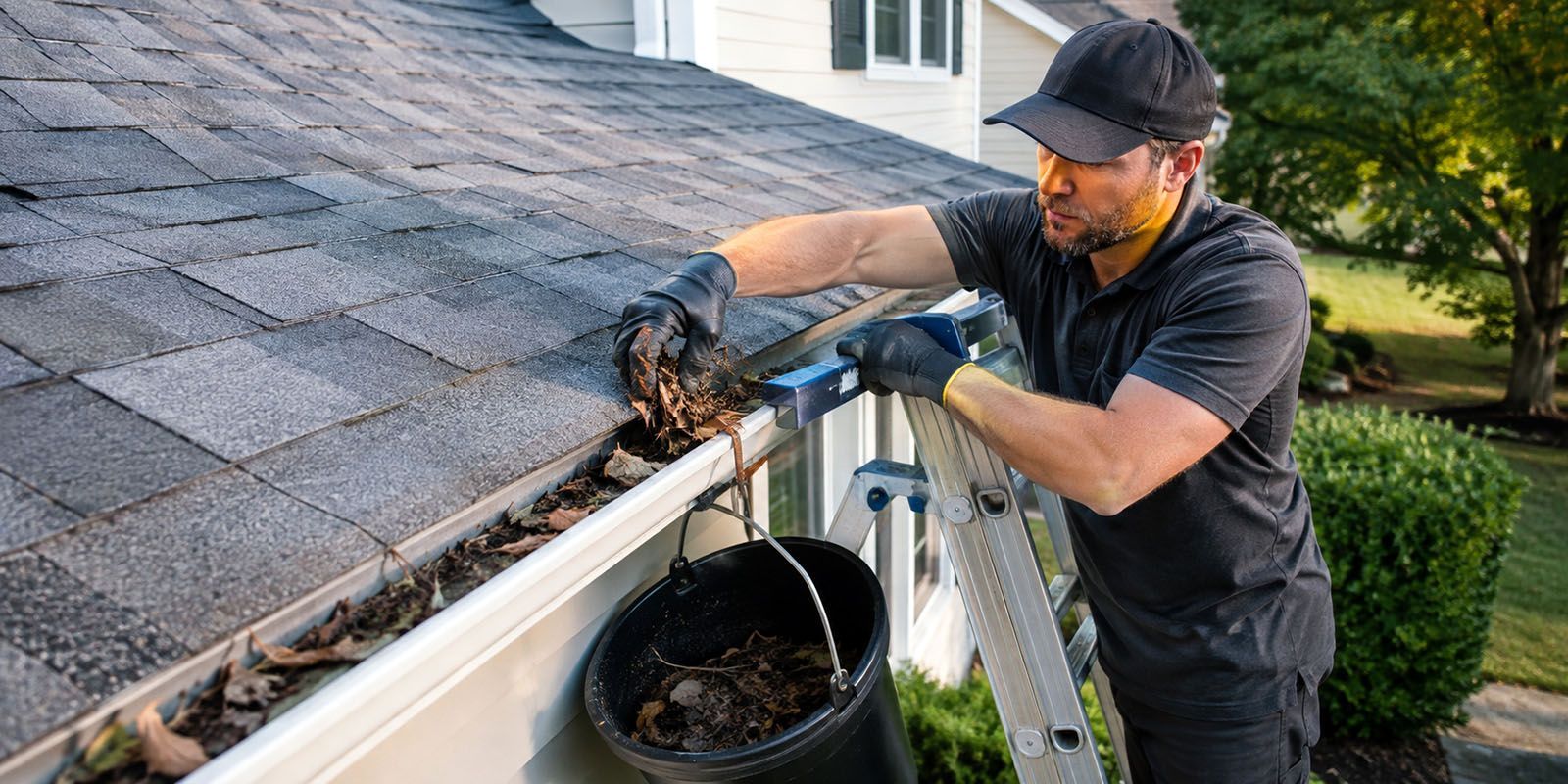
1. Work in short sections. Clear the arm’s-length span in front of you, then climb down and move the ladder. Expect to move it many times. That’s the job.
2. Scoop from the downspout outward. Start near the downspout opening and work away from it, so you’re not pushing debris into the outlet and packing it.
3. Drop debris into the hooked bucket, not onto the ground. Wet leaf muck stains walkways and smothers plantings, and you’ll spend longer cleaning that up than you saved.
4. Watch for wildlife. Nesting birds, wasp nests under the eave, and squirrels are all common. Back off and deal with it separately rather than reaching into something you can’t see.
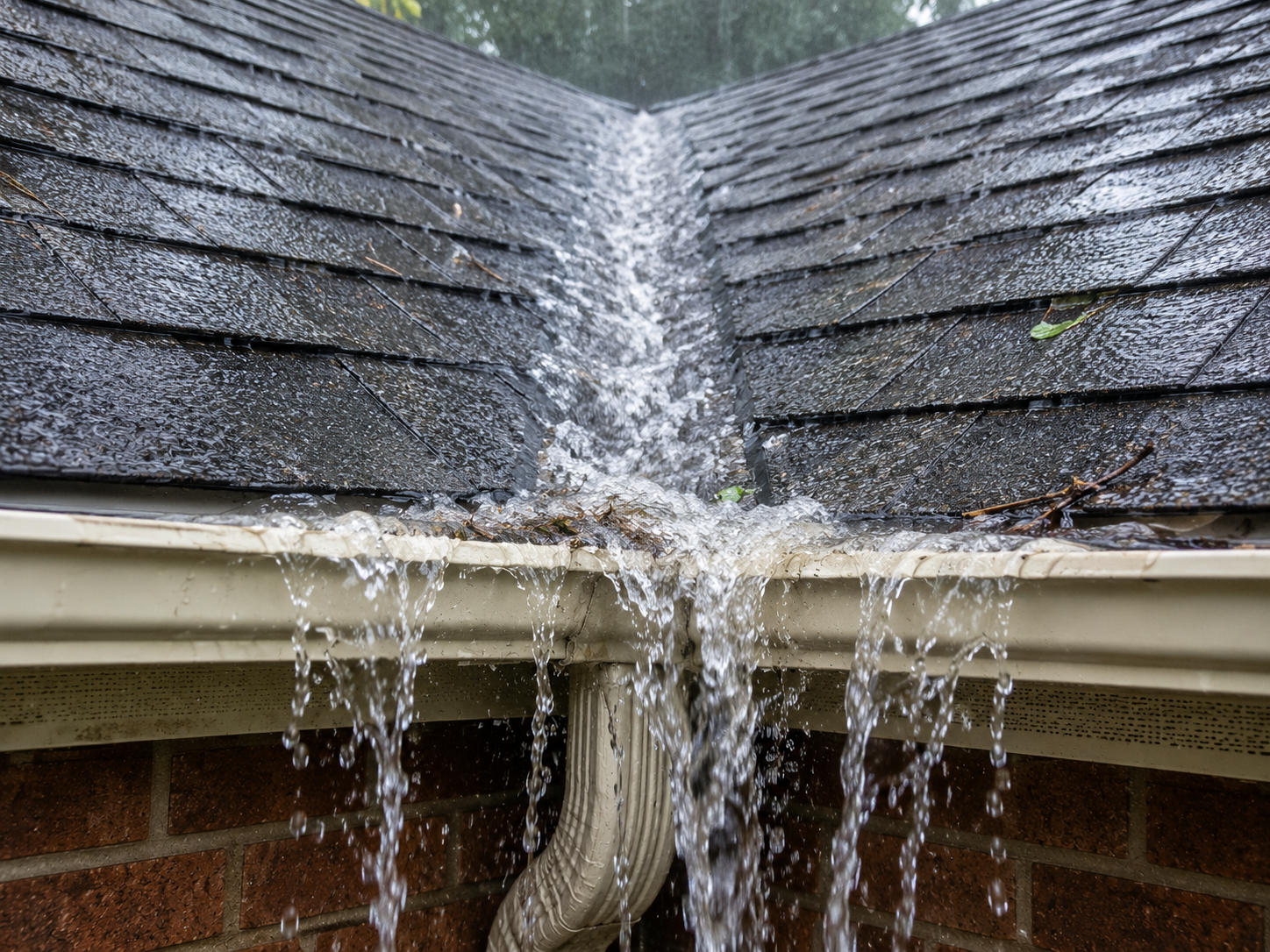
5. Flush with the hose once the bulk is out. Run water from the far end toward the downspout and watch how it flows. Slow drainage or pooling in a section means the gutter has lost pitch or a hanger has let go.
6. Check the downspouts. With the gutters clear, water should run freely out the bottom. If it doesn’t, tap along the length to find the blockage, then flush from the bottom up with the hose, or feed a plumber’s snake down from the top. A clear gutter feeding a clogged downspout still overflows.
7. Inspect while you’re up there. This is the part almost everyone skips, and it’s genuinely valuable — you’ll never have a better look at your roofline. Note loose or pulling hangers, separated seams, rust spots, sagging runs, peeling paint or soft spots on the fascia, and a heavy accumulation of shingle granules, which is a sign the roof is aging.
The mistakes that cause the damage
- Leaning the ladder directly on the gutter. The gutter is thin aluminum on spaced hangers. It will dent, and it can pull away from the fascia with you on the ladder. Use a stabilizer.
- Pressure washing. It will strip granules off shingles, force water up under them, and blow apart gutter seams. A garden hose is the right tool.
- Walking on a wet, steep, or algae-covered roof. Wet shingles and wet metal roofs are far slicker than they look.
- Working in wind. A gust against an extended ladder is more force than most people expect.
- Using a metal ladder near power lines. Fiberglass is the right choice for any home where the service drop comes anywhere near your working area.
- Reaching instead of moving. Covered above, and worth repeating, because it’s the single most common way this goes wrong.
- Going up on ice. Frozen debris doesn’t scoop, and ladders slide on frost. Winter cleaning is a professional job.
The question worth asking afterward
If you’ve just spent a weekend afternoon on a ladder, dragging a bucket of wet leaves along your roofline, it’s fair to ask how many more times you want to do this.
For most homes, gutters need clearing at least twice a year, and heavily wooded properties need it more. Over a decade, that’s a lot of ladder time — and every one of those trips carries the same risk as the last.
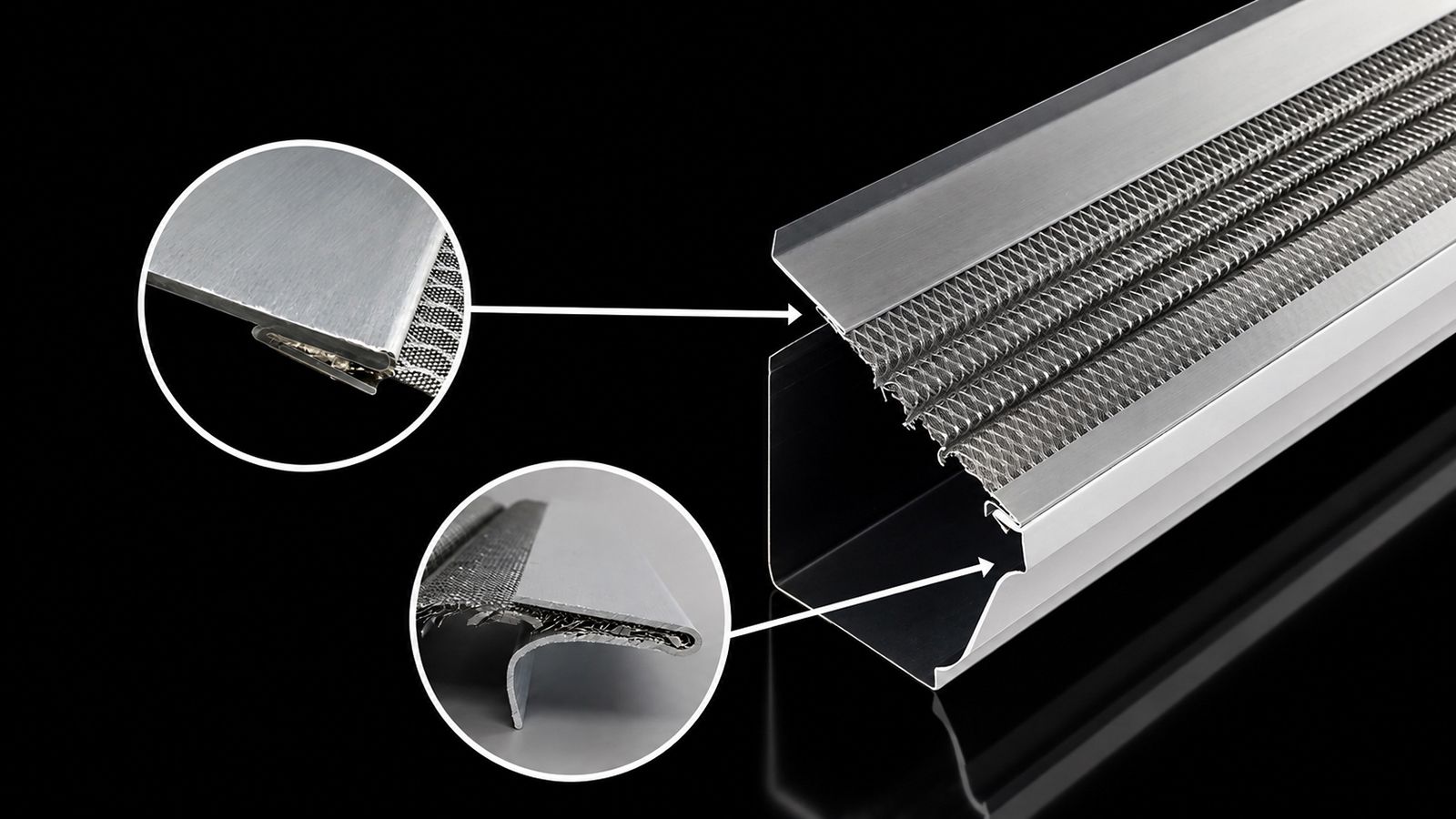
That’s the actual argument for gutter protection. A properly specified micro-mesh system doesn’t reduce the chore; it removes the conditions that create it. Debris stays on top of the mesh, dries out, and blows or washes off, while water passes through into the gutter.
Our two micro-mesh lines both handle up to 60 gallons per minute. The
Leaf Solution Gutter Guard uses 42-mesh surgical stainless steel with 440-micron openings and a patented Triple-Dip Capillary Diversion System that pulls water into the gutter.
Xtreme is a flat surgical stainless micro-mesh available in two densities so it can be matched to your rainfall. For properties where the debris is mostly leaves and sticks rather than fine material,
New Wave is a punched aluminum option.
If you’re weighing it,
here’s what to look for in a micro-mesh system and
an honest look at whether gutter guards actually work.
Frequently asked questions
How do you clean gutters safely? Work from a properly rated ladder set at a 4-to-1 angle on firm, level ground, fitted with a stabilizer so it braces against the fascia rather than resting on the gutter. Wear cut-resistant gloves and eye protection, keep three points of contact, and move the ladder rather than reaching. Scoop debris into a hooked bucket working outward from the downspout, then flush with a garden hose and confirm the downspouts run clear. If the home is two stories or more, the ground is uneven, or power lines are nearby, hire a professional instead.
What is the safest way to set up a ladder for gutter cleaning? Place the base one foot out from the wall for every four feet of height to the contact point, on firm and level ground. Use a ladder stabilizer so the load is carried by the fascia or roof rather than the gutter itself. If you’re stepping onto the roof, the ladder should extend about three feet above the edge. Have someone foot the ladder, and never stand on the top three rungs.
How often should gutters be cleaned? Most homes need it at least twice a year, typically in late spring and again after leaf fall. Properties with heavy tree cover, especially pines, often need three or four visits a year. If water overflows the front edge during ordinary rain, the gutters need attention regardless of when they were last done.
Can you clean gutters with a pressure washer? It isn’t recommended. Pressure washing strips protective granules from shingles, can force water up underneath them, and can blow gutter seams apart. A garden hose with a standard spray nozzle provides enough flow to flush a gutter once the bulk debris has been removed by hand.
Is it worth paying someone to clean gutters? For many homes, yes. Professional crews carry proper equipment, work at height routinely, and are insured for it. That’s especially true for two-story homes, steep or slick roofs, uneven ground, or anyone who would be working alone. The risk of a serious fall is the main cost of doing it yourself, and it’s the one people consistently underestimate.
The bottom line
Gutter cleaning is straightforward work done in a dangerous place. If you’re going to do it, do it with the right ladder, a stabilizer, dry conditions, and someone else at home — and move the ladder every single time you’re tempted to lean.
And if you find yourself doing it more than twice a year, the problem probably isn’t your technique.
Find a Certified Installer and find out what it would take to stop climbing up there.
Related reading:
How Long Do Gutter Guards Last? ·
What to Look For in a Micro-Mesh Gutter Guard ·
Gutter Guards and Ice Dams